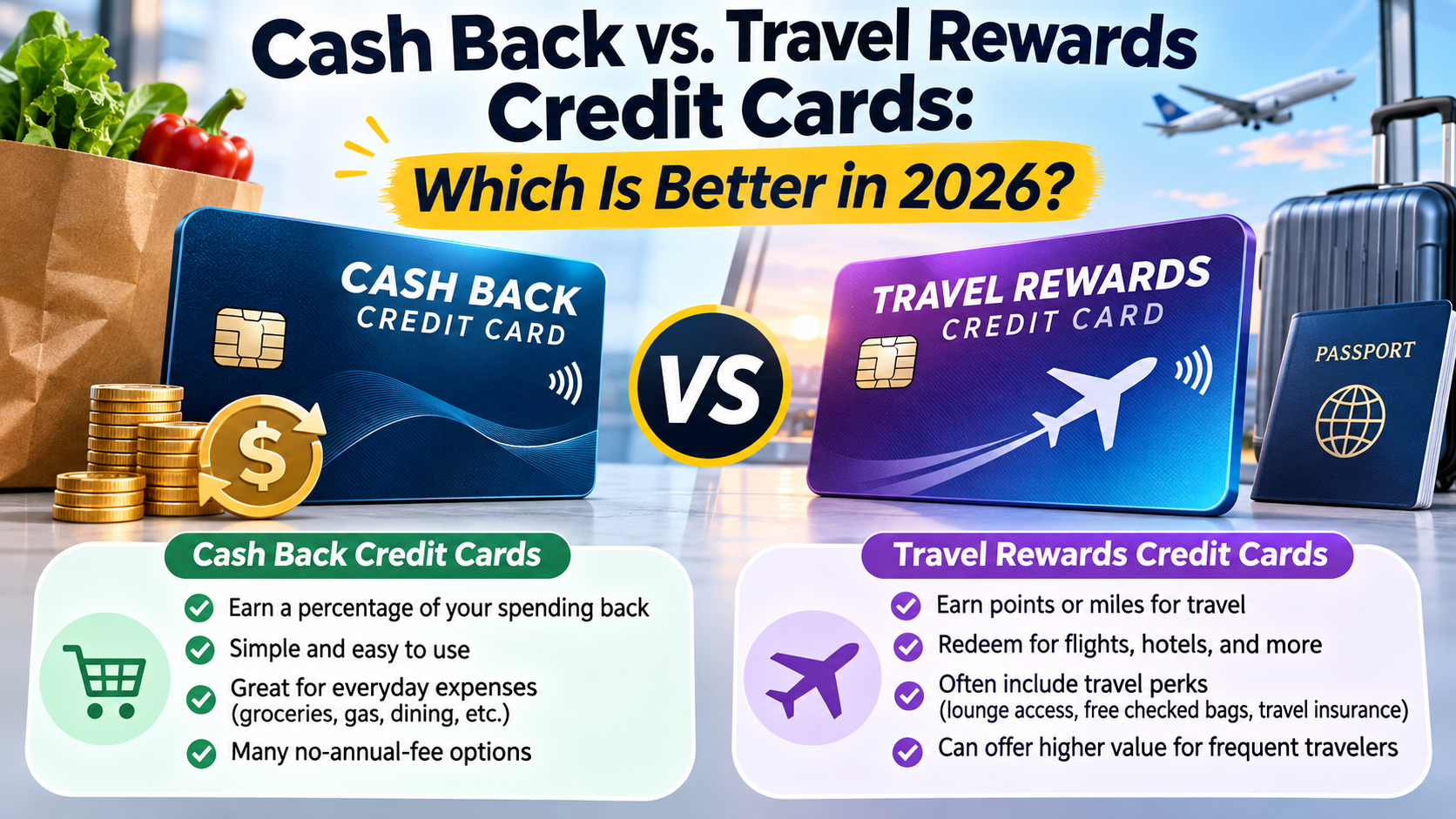
Cash Back vs. Travel Rewards Credit Cards: Which Is Better in 2026?
Choosing the right credit card can make a noticeable difference in how much value you get from everyday spending. In 2026, two popular options continue to attract American consumers: cash back credit cards and travel rewards credit cards.
Both allow you to earn rewards on purchases you already make, but they work differently. Cash back cards offer straightforward savings, while travel rewards cards can help reduce the cost of flights, hotels, and vacations.
The better choice depends on your spending habits, financial goals, and how often you travel. Someone who rarely leaves their hometown may benefit more from cash back, while a frequent traveler could get greater value from airline miles and hotel points.
This guide explains how both types of cards work, their advantages and disadvantages, and how to decide which option makes the most financial sense in 2026.
What Are Cash Back Credit Cards?
Cash back credit cards reward you with a percentage of the money you spend on eligible purchases.
For example, if your card offers 2% cash back and you spend $1,000, you earn $20 in rewards. Over time, those small amounts can turn into meaningful savings.
Most cash back cards use one of three reward structures:
Flat-rate cash back: Earn the same percentage on nearly every eligible purchase.
Bonus-category cash back: Earn higher rewards on categories such as groceries, restaurants, gas, or online shopping.
Rotating-category cash back: Receive increased rewards in selected spending categories that change periodically, sometimes requiring activation.
Depending on the card, you may redeem rewards as statement credits, bank deposits, gift cards, or other options.
The biggest advantage is simplicity. You generally know how much your rewards are worth without comparing airline programs or researching redemption rates.
What Are Travel Rewards Credit Cards?
Travel rewards credit cards let cardholders earn points or miles that can be redeemed for travel-related expenses.
Instead of receiving a percentage of spending directly as cash, you collect rewards that may be used for flights, hotel stays, rental cars, or other eligible purchases.
Some cards earn flexible points, while others are connected to specific airlines or hotel chains.
Travel cards may also include benefits such as:
Airport lounge access
Travel insurance or certain travel protections
Free checked baggage
Hotel status benefits
Statement credits for eligible travel expenses
No foreign transaction fees
Not every travel card provides these features, and eligibility conditions vary.
A major attraction is the opportunity to obtain more value from points through certain travel redemptions. However, finding those opportunities can require flexibility, planning, and patience.
Cash Back vs. Travel Rewards: Key Differences
| Feature | Cash Back Cards | Travel Rewards Cards |
|---|---|---|
| Rewards | Cash or cash equivalents | Points or miles |
| Best for | Everyday spending | Frequent travelers |
| Redemption | Usually straightforward | Can be more complicated |
| Annual fees | Many no-fee options | No-fee and premium options |
| Reward value | Generally predictable | Depends on redemption |
| Extra benefits | Spending bonuses | Travel-related perks |
| Flexibility | Broad cash usage | Often tied to travel programs |
Neither category is automatically better. The value depends on how you actually use the card.
Benefits of Cash Back Credit Cards
1. Simple and Predictable Rewards
One reason Americans choose cash back cards is that the reward value is relatively easy to understand.
If you earn $150 in cash back, that typically represents $150 in available redemption value, subject to the card's terms.
You do not need to search for available award flights or calculate the value of hotel points.
2. Useful for Everyday Expenses
Groceries, gas, dining, utilities, and online purchases are common household expenses.
A well-matched cash back card can reward these regular transactions without requiring you to change your lifestyle.
For families managing monthly budgets, this can make cash back particularly appealing.
3. Many Cards Have No Annual Fee
Numerous cash back credit cards are available without annual fees.
That means qualifying cardholders can collect rewards without paying a yearly membership cost.
A no-annual-fee structure is especially useful for people who want a simple, long-term card.
4. Flexible Redemption Options
Cash back can help offset expenses beyond travel.
You might use rewards to reduce your credit card statement, add money to savings, or cover part of a household purchase.
This flexibility can be valuable when financial priorities change.
Disadvantages of Cash Back Credit Cards
Despite their benefits, cash back cards have limitations.
Some cards offer relatively low rewards on purchases outside selected categories. Others place spending caps on higher earning rates.
Rotating rewards can also require extra attention. Forgetting to activate a category may mean missing bonus rewards.
Additionally, cash back cards may lack premium travel benefits available with certain travel-focused products.
For someone who flies frequently, missing out on baggage benefits or airport lounge access could be a meaningful disadvantage.
Benefits of Travel Rewards Credit Cards
1. Potential for Higher Redemption Value
Travel points sometimes deliver greater value than a standard cash redemption.
Imagine earning 40,000 points and finding a flight redemption worth $600, after accounting for any required taxes and fees.
That would represent 1.5 cents per point.
However, another redemption might produce substantially less value.
The important point is that travel rewards offer potential value rather than a guaranteed return.
2. Valuable Travel Perks
Certain travel cards provide benefits that can reduce travel expenses or improve convenience.
For example, an eligible free checked bag benefit could save money on multiple flights throughout the year.
Travel protections may also provide value when covered trips are delayed or interrupted, although exclusions and coverage limits apply.
3. Rewards for Travel Purchases
Many travel-focused cards provide bonus points on eligible airfare, hotel reservations, and travel bookings.
Frequent travelers may accumulate rewards faster when their regular purchases align with the card's bonus categories.
4. International Travel Convenience
Some travel rewards cards do not charge foreign transaction fees.
This can help travelers avoid an additional percentage-based charge on purchases made abroad.
However, cardholders should still consider exchange-rate practices, merchant currency conversion offers, and other possible charges.
Disadvantages of Travel Rewards Credit Cards
Travel cards can require more work to use effectively.
Points may have different values depending on the airline, hotel, booking method, or date.
Award availability may be limited, particularly during busy travel periods.
Some programs also change redemption prices, which can reduce the purchasing power of accumulated points.
Another concern is annual fees. A premium card may offer attractive benefits, but those benefits provide little financial value if you rarely use them.
Finally, certain travel credits come with restrictions that make them less flexible than cash.
Which Card Offers More Value in 2026?
The easiest way to compare rewards is to use your actual annual spending.
Consider someone who spends $20,000 per year on eligible credit card purchases.
Example A: Cash Back Card
With a flat 2% reward rate:
Annual spending: $20,000
Cash back earned: $400
Annual fee: $0
Total annual reward value: $400
Example B: Travel Rewards Card
Suppose a travel card earns an average of 2 points per dollar across the same purchases.
Annual points earned: 40,000
If redeemed at 1.5 cents per point, the rewards would be worth $600.
With a $95 annual fee:
Net annual reward value: $505
In this hypothetical example, the travel card comes out ahead by $105.
But if those same points are redeemed at only 1 cent each, their value falls to $400. After the annual fee, the net value becomes $305.
The cash back card would then be the better financial choice.
These examples illustrate why earning rates alone do not determine which card delivers better value.
Annual Fees: Are They Worth Paying?
Annual fees deserve serious attention when comparing credit cards.
Some travel cards charge modest annual fees, while premium products may cost several hundred dollars per year.
A card with a $95 annual fee must generate at least $95 in additional value compared with a suitable no-fee alternative simply to break even.
That value might come from better rewards, useful travel protections, or benefits you would otherwise pay for.
However, advertising a $200 travel credit does not automatically make a card worth $200 more to you.
If the credit requires spending you would not normally make, its practical value could be much lower.
Always estimate benefits based on your existing habits rather than assuming you will use every advertised perk.
Who Should Choose a Cash Back Credit Card?
Cash back is often the more practical choice for people who prioritize simplicity and financial flexibility.
It may be particularly suitable for:
Families spending heavily on groceries and household essentials
People who travel only occasionally
Consumers who prefer avoiding annual fees
Beginners learning how rewards cards work
Anyone who wants easily understood reward values
For these users, receiving consistent cash rewards may be more useful than collecting airline points for an uncertain future trip.
Cash back also eliminates much of the time required to research travel loyalty programs.
Who Should Choose a Travel Rewards Credit Card?
A travel card may be a better fit for someone who regularly books flights, stays in hotels, or travels internationally.
It can also benefit people who are comfortable comparing redemption options and adjusting travel dates to find better value.
Travel rewards deserve consideration if you:
Fly several times a year
Frequently stay in hotels
Can use the card's travel benefits
Understand points and miles programs
Pay your monthly statement balance in full
The strongest candidates are travelers who receive genuine savings from both earned rewards and included benefits.
Can You Use Both Types of Credit Cards?
Yes. Some consumers combine a cash back card with a travel rewards card.
For example, a travel card might be used for purchases that earn bonus travel points, while a flat-rate cash back card handles spending that does not qualify for a bonus.
This approach can increase flexibility, but it also introduces additional accounts, payment dates, and reward programs.
Managing multiple cards is not necessary for everyone.
If maintaining several accounts encourages overspending or makes bills harder to track, a single well-chosen card may be the smarter option.
Important Credit Card Mistakes to Avoid
The biggest rewards mistake is focusing on points while ignoring borrowing costs.
Credit card interest rates remain high enough that carrying a balance can quickly erase the benefits of earning rewards.
A person receiving $30 in monthly rewards could lose far more than that through interest charges.
Other common mistakes include applying for a card solely because of its welcome bonus, overlooking annual fees, and purchasing unnecessary items to earn additional points.
Consumers should also understand introductory offers, bonus eligibility requirements, redemption restrictions, and the possibility of reward program changes.
The safest strategy is to use a rewards card for planned purchases, monitor the account regularly, and pay the full statement balance by the due date whenever possible to preserve the purchase grace period.
If you routinely carry debt, a lower-interest card may provide more value than either rewards category.
How to Choose the Right Credit Card in 2026
Before submitting an application, review your spending over the previous three to six months.
Identify where most of your money goes. Is it groceries, restaurants, gas, airfare, or hotels?
Next, estimate how many rewards you would earn annually under each card's current terms.
Subtract annual fees and consider only the benefits you are likely to use.
For travel cards, compare realistic redemption options rather than relying on promotional valuations.
Finally, review the card's APR, credit requirements, fees, and reward conditions. Approval is not guaranteed, and the terms available to you may depend on your credit profile.
Final Verdict: Cash Back or Travel Rewards?
In 2026, cash back credit cards are generally the better starting point for consumers who want simple, flexible rewards from everyday purchases.
They provide predictable value and frequently come with no annual fee.
Travel rewards credit cards can deliver greater value for frequent travelers who understand redemption programs and consistently use travel-related benefits.
The right decision is not about which card offers the largest advertised bonus. It is about which card rewards the spending you already do without adding unnecessary costs.
Choose the card that fits your real financial life, not the lifestyle suggested by its marketing.
Frequently Asked Questions
Is cash back better than travel points?
Cash back is usually easier to redeem and has a more predictable value. Travel points may be worth more when used for favorable flight or hotel redemptions.
Are travel rewards credit cards worth it in 2026?
They can be worthwhile for frequent travelers who earn enough rewards and use enough benefits to justify any annual fee.
Can credit card rewards expire?
Some rewards may expire or be forfeited under certain conditions. Rules vary by issuer and loyalty program, so review the applicable terms.
Do rewards credit cards help build credit?
Rewards cards can contribute to building credit when account activity is reported to credit bureaus. Paying on time and keeping balances manageable are more important than the type of rewards earned.
Should beginners choose cash back or travel rewards?
For many beginners, a no-annual-fee cash back card is an easier place to start because its rewards are straightforward and its ongoing costs may be lower.