7 Credit Card Mistakes That Can Hurt Your Credit Score in 2026
Credit cards can make everyday purchases more convenient, help cover unexpected expenses, and even allow you to earn valuable rewards. When used responsibly, they can also help you build a strong credit history. However, a few seemingly harmless mistakes can damage your credit score and make borrowing money more expensive.
Many Americans use credit cards regularly without fully understanding how their spending and payment habits affect their credit profiles. Something as simple as missing a payment, using too much of your available credit, or closing an old account could have consequences.
Your credit score plays an important role in your financial life. Mortgage lenders, auto financing companies, and credit card issuers often use credit scores to evaluate applications and determine borrowing terms.
The good news is that most credit card mistakes are preventable. By understanding what affects your score and developing better financial habits, you can protect your credit history.
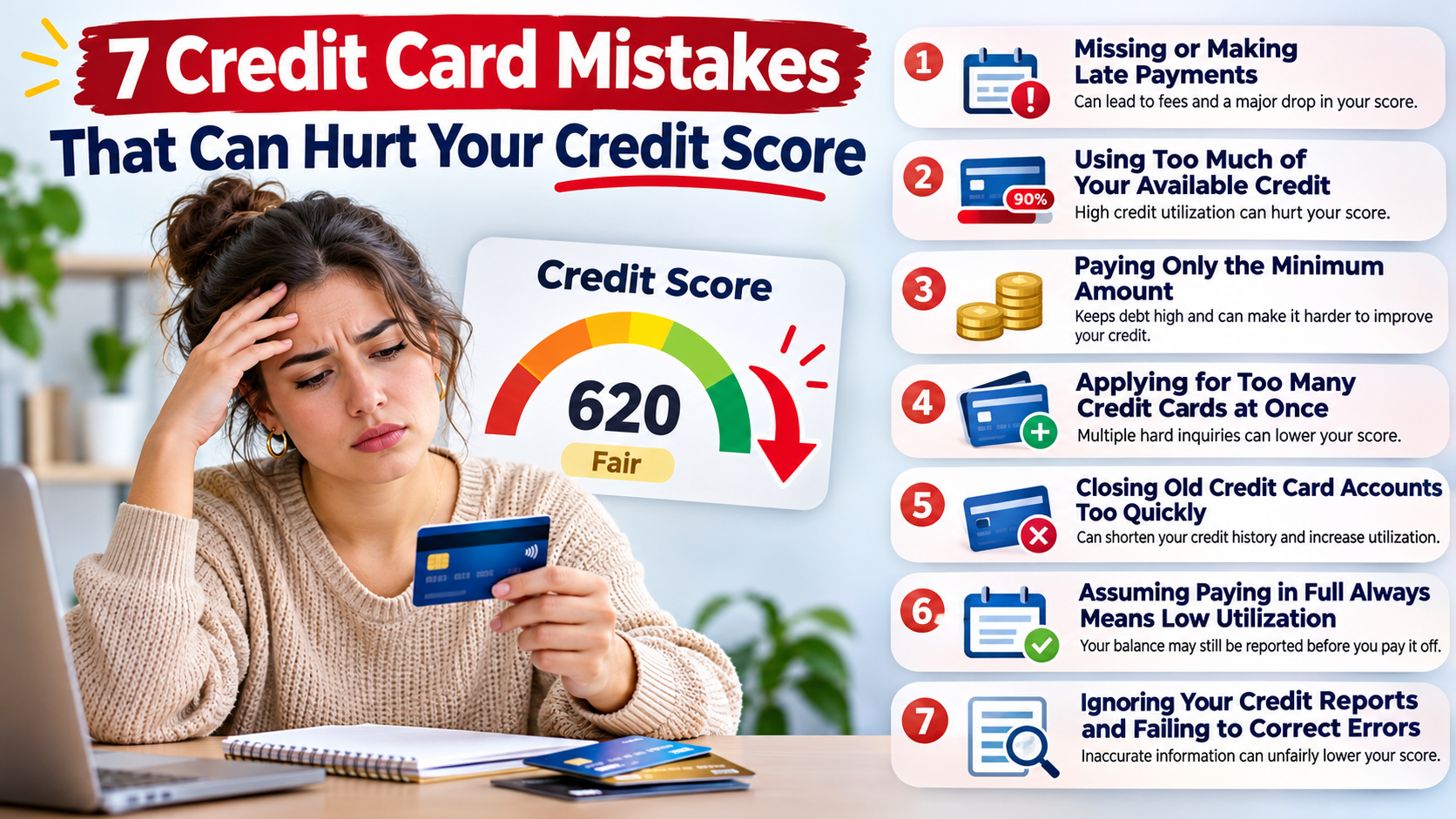
Here are seven common credit card mistakes to avoid in 2026.
1. Missing or Making Late Credit Card Payments
One of the most damaging credit card mistakes is failing to pay your bill on time.
Payment history accounts for approximately 35% of a typical FICO credit score, making it the largest individual scoring category. Lenders want to know whether you consistently meet your financial obligations.
Imagine that you have maintained excellent credit for several years. Then, during a particularly busy month, you forget to pay your credit card bill.
Even one missed payment can create problems.
Credit card issuers may charge late fees when payments are not received by the applicable deadline. Payments that become at least 30 days overdue are generally eligible to be reported as late to credit bureaus.
Once reported, a late payment can remain on your credit report for up to seven years, although its impact generally becomes less significant over time.
How to avoid this mistake:
Set up automatic payments for at least the minimum amount due.
Enable payment reminders through your banking application.
Review your credit card statements every month.
Keep enough money in your checking account to cover scheduled payments.
If you accidentally miss a payment, contact your credit card company immediately. Paying as soon as possible may prevent the account from becoming 30 days overdue.
Developing a consistent payment routine is one of the simplest ways to protect your credit score.
2. Using Too Much of Your Available Credit
Another common mistake is allowing credit card balances to approach their credit limits.
This affects something called your credit utilization ratio, which measures how much of your available revolving credit you are currently using.
For example, suppose your credit card has a $5,000 limit.
If your reported balance is $1,000, your credit utilization is 20%.
However, if your balance increases to $4,500, your utilization reaches 90%.
A high utilization ratio can signal that you are relying heavily on borrowed money, even if you have never missed a payment.
Amounts owed, which includes credit utilization, represents approximately 30% of a typical FICO score.
Financial experts commonly recommend keeping utilization below 30%, although this is a guideline rather than a guaranteed scoring threshold. Lower utilization can be better, depending on your overall credit profile.
How to avoid this mistake:
Try to keep your balances comfortably below your limits. If possible, make additional payments during the billing cycle rather than waiting until the due date.
For example, someone who spends $2,000 monthly on a card with a $3,000 limit could make an early payment to reduce the balance reported to credit bureaus.
Remember that utilization matters both across your credit cards collectively and on individual accounts.
You do not necessarily need to stop using credit cards. Instead, focus on maintaining manageable reported balances and avoiding unnecessary debt.
3. Paying Only the Minimum Amount Every Month
Credit card companies allow customers to make minimum monthly payments instead of paying their entire statement balance.
While this flexibility can be helpful during financial emergencies, relying on minimum payments for long periods can become expensive.
Consider someone who has a $3,000 credit card balance with a relatively high annual percentage rate.
Making only the minimum payment may keep the account current, but much of the balance can remain unpaid for months or years.
Meanwhile, interest charges continue to accumulate.
It is important to understand that paying the minimum on time does not directly damage your credit score. The problem arises when persistent debt keeps your reported balances high or eventually makes payments difficult to afford.
A balance that grows faster than you can repay it can gradually increase financial pressure.
How to avoid this mistake:
Whenever your budget allows, pay the full statement balance by the due date.
If that is not possible, aim to pay substantially more than the minimum.
You can also create a repayment plan that prioritizes cards with the highest interest rates.
Reducing outstanding debt can improve your financial flexibility while potentially benefiting your credit utilization.
The goal is to use credit cards as convenient financial tools rather than long-term sources of expensive borrowing.
4. Applying for Too Many Credit Cards Within a Short Period
Credit card companies frequently advertise welcome bonuses, cashback offers, travel rewards, and introductory interest rates.
These promotions can be attractive, particularly for people who want to maximize their rewards.
However, submitting several credit card applications within a short period may negatively affect your credit score.
When you formally apply for a credit card, the lender generally performs a hard credit inquiry.
Hard inquiries can cause small, temporary reductions in credit scores. Opening several new accounts can also reduce the average age of your credit history.
For example, someone who applies for four different credit cards within two months may experience more scoring pressure than someone who applies for one card.
Lenders may also interpret numerous recent applications as a sign of increased borrowing needs.
How to avoid this mistake:
Research credit cards before submitting applications.
Compare important features such as annual fees, interest rates, rewards programs, and eligibility requirements.
Where available, use prequalification tools that rely on soft credit inquiries, which do not affect your credit score.
Apply for new cards when they provide a genuine financial benefit rather than simply because an advertisement offers a bonus.
Being selective with applications can help protect your credit profile.
5. Closing Old Credit Card Accounts Without Considering the Impact
Many people assume that closing an unused credit card automatically improves their credit score.
Unfortunately, the opposite can sometimes happen.
Older credit cards may contribute positively to your credit history. They can also provide additional available credit, helping keep your overall utilization ratio lower.
Suppose you have two credit cards, each with a $5,000 credit limit.
Your combined available credit is $10,000, and you currently owe $2,000.
Your utilization ratio is 20%.
If you close one card and your available credit drops to $5,000, that same $2,000 balance represents 40% utilization.
Even though your debt has not increased, your credit score could decline because a larger percentage of your available credit is being used.
Closing an account does not necessarily erase its positive payment history immediately. Accounts closed in good standing can remain on credit reports for years.
How to avoid this mistake:
Before closing an older credit card, evaluate its annual fee, available credit, and usefulness.
If the account has no annual fee and you can manage it responsibly, keeping it open may be beneficial.
You could occasionally use it for a small planned purchase and pay the statement balance in full.
However, keeping every card open is not always the best decision. Closing an expensive account or one that encourages overspending may make financial sense.
Your overall financial health should remain the priority.
6. Assuming Paying in Full Always Means Low Credit Utilization
This mistake surprises many responsible credit card users.
You might pay your credit card balance in full every month and still notice that your credit score fluctuates.
The reason is that credit card issuers generally report account information to credit bureaus periodically, often around the statement closing date.
Your payment due date and statement closing date are not the same.
For example, imagine that your credit card has a $2,000 limit.
You spend $1,600 during the billing cycle and receive a statement showing that balance.
Even if you pay the full $1,600 by the payment due date, your issuer may already have reported a balance representing 80% utilization.
Your credit score may temporarily reflect that high reported balance.
This does not mean you made a late payment or that you need to carry debt and pay interest to build credit.
How to avoid this mistake:
Learn when your credit card statement closes and when your issuer typically reports account balances.
If you are preparing to apply for a mortgage, car loan, or other major financing, consider reducing high balances before the reporting date.
Making an additional payment before the statement closes can sometimes lower the amount reported.
Most importantly, continue paying your full statement balance by the due date whenever possible.
This approach helps you manage both your interest costs and reported credit utilization.
7. Ignoring Your Credit Reports and Failing to Correct Errors
Your credit score depends on information recorded in your credit reports.
Unfortunately, credit reports can sometimes contain inaccurate or outdated information.
An incorrectly reported late payment, unfamiliar account, or inaccurate balance could negatively affect your creditworthiness.
These issues may remain unnoticed if you never review your reports.
In the United States, the three major nationwide credit reporting companies are Equifax, Experian, and TransUnion.
Consumers can access free weekly credit reports from each company through the federally authorized AnnualCreditReport.com service.
Checking your own credit report does not lower your credit score.
How to avoid this mistake:
Review your credit reports regularly and pay attention to:
Accounts that you do not recognize.
Incorrectly reported late payments.
Inaccurate credit limits or balances.
Duplicate accounts or collection records.
Signs of possible identity theft.
If you discover an error, dispute it with the appropriate credit reporting company and, when appropriate, the lender that supplied the information.
Provide supporting documentation explaining why the information is incorrect.
Monitoring your credit reports can help you identify problems before they interfere with important financial decisions.
How to Build Better Credit Card Habits in 2026
Avoiding these seven mistakes is an excellent starting point, but improving your credit score requires consistent financial habits.
Start by creating a realistic monthly budget that includes your credit card spending and repayment obligations.
Try to use credit cards only for purchases you can reasonably afford to repay.
Set up payment alerts, keep your credit utilization manageable, and review statements for unexpected charges.
If you already have substantial credit card debt, focus on reducing balances gradually instead of opening additional accounts without a clear repayment strategy.
Remember that credit scores do not improve overnight.
Your progress depends on your starting credit history, the information lenders report, and the scoring model being used.
Positive habits practiced consistently over time can help you build a stronger credit profile.
Frequently Asked Questions
Can one late credit card payment ruin my credit score?
A single reported late payment can cause a noticeable score reduction, particularly if you previously had a strong payment history. However, the impact varies. Paying future bills on time can help you rebuild your credit over time.
Is it bad to use 100% of my credit limit?
Using your entire available credit limit generally creates a very high utilization ratio, which can negatively affect your score. Keeping reported balances low is usually better for your credit profile.
Does paying off my credit card early improve my credit score?
Paying before the statement closing date may reduce your reported balance and potentially help your utilization. However, the exact impact depends on the information reported and your overall credit history.
Do I need to carry a credit card balance to build credit?
No. Carrying a balance and paying interest are not necessary for building a good credit score. Responsible account use and on-time payments are more important.
How long does it take to improve a damaged credit score?
There is no universal timeline. Utilization-related improvements may appear after updated balances are reported, while recovery from missed payments or serious negative information can take considerably longer.
Final Thoughts
Credit cards can support your financial goals when you understand how to use them responsibly.
Missing payments, maintaining high balances, applying for unnecessary cards, and overlooking credit report errors are mistakes that can affect your credit score and future borrowing opportunities.
Fortunately, you have control over many of the habits that influence your credit health.
Focus on paying bills on time, managing debt carefully, maintaining reasonable credit utilization, and checking your credit information regularly.
A strong credit score is usually built through consistent decisions rather than shortcuts.
By avoiding these seven common credit card mistakes in 2026, you can take meaningful steps toward better financial stability and more affordable borrowing opportunities.
Disclaimer: This article is intended for general educational purposes and does not constitute personalized financial advice. Credit scoring results vary by individual circumstances and scoring model.