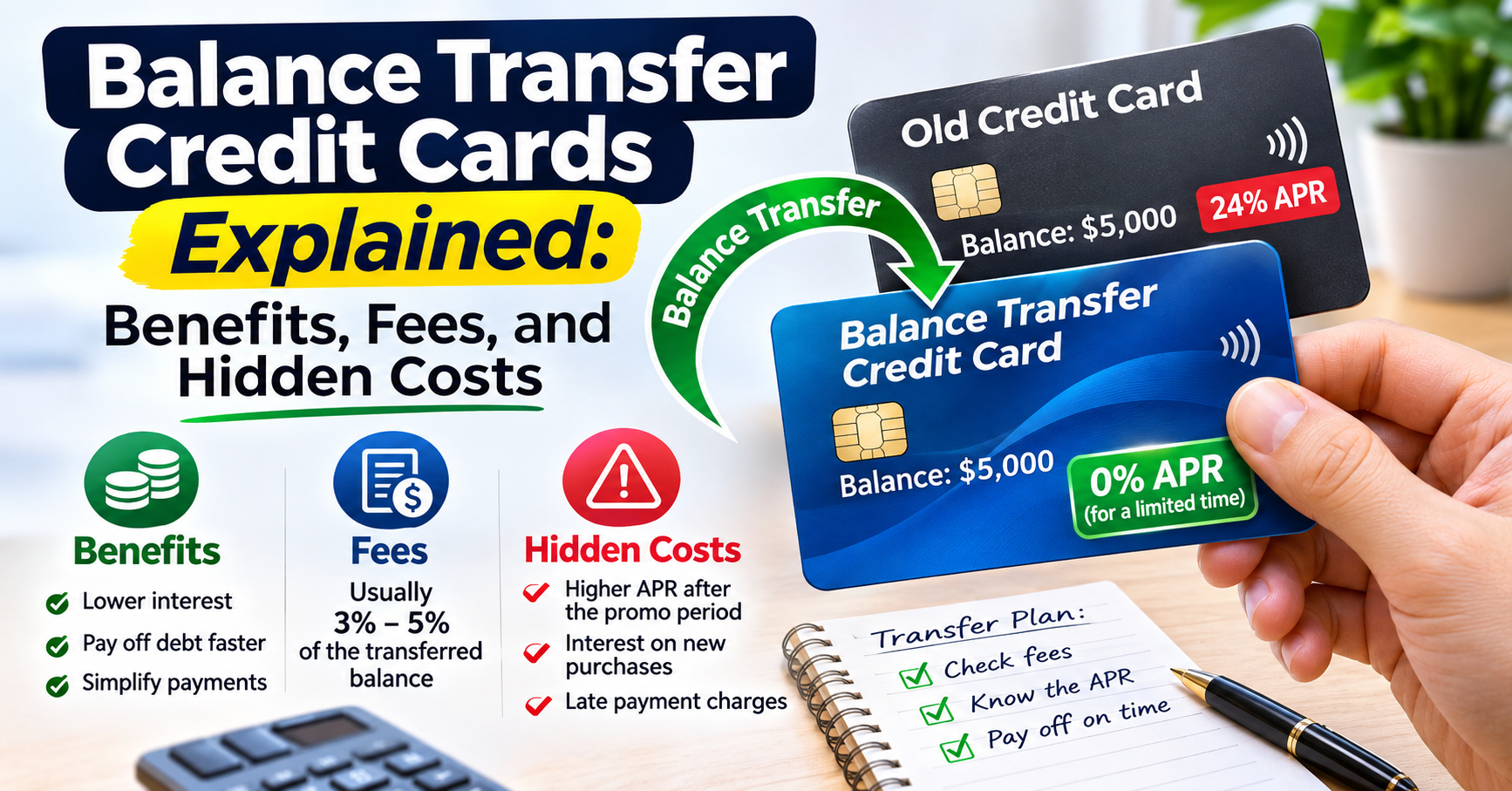
Balance Transfer Credit Cards Explained: Benefits, Fees, and Hidden Costs
Credit card debt can become difficult to manage, especially when high interest rates make it feel like your balance never goes down. You make payments every month, but a significant portion of your money goes toward interest instead of reducing what you owe.
This is where a balance transfer credit card may help.
These cards allow you to move existing credit card debt to another card, often with a temporary 0% annual percentage rate (APR). Instead of paying high interest every month, you get an opportunity to focus on paying down your actual debt.
However, balance transfers aren't completely free, and they don't automatically solve financial problems. Transfer fees, promotional deadlines, and unexpected interest charges can reduce your savings if you're not careful.
Understanding how these cards work can help you decide whether transferring your debt is the right financial move.
What Is a Balance Transfer Credit Card?
A balance transfer credit card allows you to move an outstanding balance from one credit card to another, usually to take advantage of a lower interest rate.
For example, imagine you have $5,000 in debt on a credit card charging 24% APR. At that rate, interest can add a substantial amount to your monthly expenses.
Now suppose you qualify for a new credit card offering 0% introductory APR on balance transfers for 18 months.
By transferring your existing balance to the new card, you may avoid interest on the transferred amount during that promotional period.
This gives you more time to repay your debt without additional interest accumulating on that balance.
The important thing to remember is that a balance transfer doesn't eliminate debt. It simply moves the amount you owe to a different account, potentially with better repayment terms.
How Do Balance Transfer Credit Cards Work?
The process is relatively straightforward.
First, you apply for a credit card that offers promotional balance transfer terms. If approved, the card issuer provides a credit limit based on your creditworthiness and financial information.
You then request a transfer from your existing credit card to the new account.
Once the transfer is completed, your new card issuer pays the approved amount toward your old credit card balance. That transferred amount, along with any applicable fee, becomes part of your new card balance.
You repay the new card according to its terms.
Some cards offer promotional periods lasting 12, 15, 18, or even 21 months. The specific duration depends on the issuer and offer.
Remember that approval for a new card does not guarantee that your entire existing balance can be transferred. Your available credit limit and any applicable fees may restrict the transfer amount.
Major Benefits of Balance Transfer Credit Cards
1. Save Money on Interest
The biggest advantage is the possibility of reducing interest expenses.
When your existing credit card has a high APR, interest can slow your debt repayment progress.
A 0% introductory APR gives you a temporary break from interest charges on the transferred balance.
If you use that time wisely, you can direct more of your monthly payment toward the debt itself.
2. Pay Off Debt Faster
Without ongoing interest charges on the promotional balance, every qualifying payment reduces what you owe, including any transfer fee added to the account.
This makes it easier to create a predictable repayment schedule.
For example, if you transfer a balance and plan to eliminate it within 18 months, you can calculate how much to pay each month rather than guessing.
3. Combine Multiple Credit Card Balances
Managing several credit cards can become stressful.
Different payment dates, interest rates, and minimum payments make it easier to overlook bills.
Depending on your credit limit and issuer rules, a balance transfer card may allow you to consolidate balances from multiple credit cards into one account.
This can simplify monthly budgeting.
However, consolidation is helpful only when you avoid accumulating new debt on the cards you previously paid off.
4. Gain More Control Over Your Finances
A balance transfer can provide breathing room while you reorganize your budget.
Instead of constantly worrying about accumulating interest, you can focus on building better spending habits and reducing your outstanding balance.
For some people, that temporary relief makes it easier to develop a realistic debt repayment strategy.
Understanding Balance Transfer Fees
One of the most important details to review before applying is the balance transfer fee.
Most balance transfer cards charge a fee based on the amount you move.
A common fee is between 3% and 5% of the transferred balance, sometimes with a minimum dollar charge.
Consider the following example:
| Transferred Balance | 3% Fee | 5% Fee |
|---|---|---|
| $2,000 | $60 | $100 |
| $5,000 | $150 | $250 |
| $8,000 | $240 | $400 |
| $10,000 | $300 | $500 |
If you transfer $5,000 with a 3% fee, you could owe $5,150 immediately after the transaction is processed.
That additional $150 is the cost of moving your debt.
While the fee may be worthwhile compared with paying high interest for another year, you should always calculate your expected savings before proceeding.
A 0% APR does not necessarily mean the transfer is free.
Hidden Costs You Should Know About
Balance transfer offers can look extremely attractive in advertisements. However, several important details may not be obvious until you read the card agreement.
1. Higher APR After the Promotional Period
A 0% introductory rate is temporary.
When the promotional period ends, the issuer generally applies its regular balance transfer APR to any remaining balance.
If your new card carries a high variable APR, leaving a large unpaid balance could become expensive.
For instance, transferring debt to a 0% card only to leave thousands of dollars unpaid after the promotion expires may eliminate much of the benefit.
The safest approach is to plan your repayment before the promotional period ends.
2. Interest on New Purchases
Many people assume that a credit card advertising 0% APR means every transaction is interest-free.
That is not necessarily true.
Some cards offer 0% APR only for balance transfers, not new purchases.
If you buy groceries, electronics, or other items using the same card, those purchases may accumulate interest at the regular purchase APR.
Carrying a promotional transferred balance may also affect the normal grace period on purchases.
To avoid unnecessary charges, consider using your balance transfer card exclusively for debt repayment.
3. Late Payment Charges
You still need to make at least the required minimum payment every month.
Missing a payment can result in late fees, credit score damage, and potentially the loss of promotional benefits under applicable terms and rules.
Setting up automatic payments can help prevent accidental missed due dates.
4. Balance Transfer Deadlines
Some introductory offers require you to complete transfers within a specific period after opening the account.
For example, a card might require transfers within the first 60 or 120 days to qualify for advertised promotional terms.
Waiting too long could mean paying a higher fee or missing the introductory rate.
Always verify the deadline in your card agreement.
5. Credit Limit Restrictions
Your new credit limit must accommodate the transfer amount and applicable fees.
If you receive a $4,000 credit limit, you generally cannot move a $5,000 balance onto that card.
Even when a partial transfer is possible, you may still have debt remaining on the original account.
Also, using most of your new credit limit can temporarily increase your credit utilization ratio, which may affect your credit score.
6. Temporary Credit Score Changes
Applying for a new credit card usually results in a hard credit inquiry.
This can cause a small, temporary decline in your credit score.
Opening a new account can also affect the average age of your credit accounts.
However, reducing outstanding debt and consistently making payments on time may support your credit health over time.
The overall effect depends on your credit profile.
Real-Life Example: How Much Could You Save?
Imagine you owe $6,000 on a credit card with a 24% APR.
You qualify for a balance transfer card offering:
0% introductory APR for 18 months
4% balance transfer fee
No annual fee
Your transfer fee would be:
$6,000 × 4% = $240
Your new balance would become $6,240.
To repay that amount over 18 months, you would need to pay approximately $346.67 per month.
If you make those payments on schedule and avoid additional charges, you could eliminate the balance during the promotional period without paying interest on the transferred debt.
Compared with carrying the original balance at 24% APR, this strategy could save a meaningful amount of money.
However, actual savings depend on how quickly you would otherwise have repaid the old card, the fees involved, and whether you complete the repayment plan.
When Is a Balance Transfer Worth It?
A balance transfer can make financial sense when you have high-interest credit card debt and a realistic plan to repay it.
It may be particularly useful if:
Your current credit card has a high interest rate.
You qualify for a competitive promotional APR.
The transfer fee is lower than the interest you expect to avoid.
You can afford monthly payments that eliminate the balance before the promotion ends.
You are committed to avoiding unnecessary new debt.
On the other hand, a balance transfer may not be the best option if your existing debt already carries a low interest rate or you cannot afford the required repayment schedule.
If your financial situation is unstable, moving debt between credit cards may simply postpone the problem.
How to Choose the Right Balance Transfer Card
Not every balance transfer offer provides the same value.
Before applying, compare several important features.
Introductory APR: Look for a low or 0% promotional rate that applies specifically to balance transfers.
Promotional duration: A longer interest-free period can make repayment more manageable, especially for larger balances.
Transfer fee: Compare fees carefully. A shorter offer with a 3% fee may sometimes cost less than a longer offer with a 5% fee.
Regular APR: Check the interest rate that applies after the introductory offer expires.
Annual fee: Consider whether an annual charge outweighs the savings you expect.
Eligibility requirements: Credit card issuers evaluate credit history, income, existing obligations, and other factors before approving applications.
Most issuers also restrict transfers between credit cards issued by the same financial institution, so confirm that your existing debt is eligible.
Smart Tips for Using a Balance Transfer Card
Getting approved is only the beginning. Your repayment habits determine whether the transfer actually helps.
Create a monthly payment target. Divide your total transferred balance, including fees, by the number of promotional months. Aim to pay enough to finish slightly early.
Avoid adding new purchases. Treat the new card as a debt repayment tool rather than extra spending money.
Continue paying the original card. Keep making required payments until the transfer is fully processed and confirmed.
Track your promotional expiration date. Add reminders to your calendar so you know exactly when the regular APR begins.
Keep an emergency fund when possible. Even a modest savings cushion can help prevent unexpected expenses from becoming new credit card debt.
Review your monthly statements. Check balances, interest charges, payments, and fees regularly.
Frequently Asked Questions
Does a balance transfer hurt your credit score?
It can temporarily affect your credit score because of the application inquiry, new account, and changes in credit utilization. The long-term impact depends on how you manage your accounts and repayments.
Can you transfer a balance from one card to another with the same bank?
Generally, major credit card issuers do not allow balance transfers between their own cards. However, policies vary, so review the issuer's rules.
What happens if you don't pay off the balance within the promotional period?
The remaining balance generally begins accruing interest at the applicable regular APR once a genuine 0% introductory APR period ends. Interest is not normally charged retroactively for the promotional months, unlike certain deferred-interest offers.
Can you make another balance transfer later?
Yes, if an issuer approves another transfer and you meet its requirements. However, repeatedly moving debt without reducing it can lead to additional fees and ongoing financial pressure.
Final Thoughts
Balance transfer credit cards can be valuable tools for people trying to escape expensive credit card interest.
A well-chosen 0% introductory APR offer may help you save money, consolidate debt, and establish a clear repayment schedule.
But the advantages come with responsibilities.
Transfer fees, expiration dates, purchase interest, and late payment consequences can turn an attractive offer into an expensive mistake.
Before applying, compare the total cost, review the terms carefully, and calculate a monthly payment you can comfortably afford.
Most importantly, remember that transferring debt is not the same as paying it off.
The real financial benefit comes from using the interest-free opportunity to reduce what you owe and build healthier financial habits.
Disclaimer: This article is for general educational purposes only and does not constitute personalized financial advice. Credit card rates, fees, eligibility requirements, and promotional offers vary by issuer and may change over time.